
A-Level Exam Technique Tutoring for Science Students
Knowing the science isn’t the same as showing it in an exam. Strong subject knowledge can still lose marks if you misread a command word, skip a calculation step or leave part of a multi-part question unanswered. A level exam technique tutoring focuses on these decisions, helping you turn what you know into clear, complete answers instead of simply adding more past-paper practice.
If the same errors keep returning, it can feel as though revision isn’t translating into results. The answer isn’t always to learn more content. First identify where your response breaks down, then practise a more reliable way to approach that type of question.
This article explains how to spot where marks are being lost, use a repeatable method for different A-level science question types and learn from mark-scheme feedback. It also covers when targeted tutoring can help connect subject understanding with clear, exam-ready responses.
Key Takeaways
- Separate subject-knowledge gaps from errors in reading, reasoning or communicating an answer to pinpoint what needs attention.
- Trace each lost mark to its cause, then choose one specific correction to practise.
- Adapt your approach to calculations, explanations and extended responses, checking the whole question as well as its command word.
- Build a practice cycle of attempting, marking, diagnosing, correcting and retesting. Add timed conditions as your accuracy develops.
- A level exam technique tutoring can help when the same errors persist, feedback is unclear or a method doesn’t transfer to unfamiliar questions.
A-level exam technique tutoring: why knowing the content is not always enough
Exam technique is the set of decisions and actions that turns relevant knowledge into an answer an examiner can credit. It includes interpreting the whole question, choosing a suitable method, showing your reasoning and checking that you have addressed every part. A-level exams assess subject knowledge through different question formats, as outlined in Understanding A-level examinations. How you communicate what you know matters alongside what you have learnt.
Subject mastery is what you understand; exam technique is how clearly and completely you demonstrate that understanding under examination conditions. A lost mark can have different causes. You might not know a biological process, or you might understand it but omit the link between cause and effect in your explanation. In maths, you might choose the right method but leave out working that makes your reasoning clear. In chemistry, a correct numerical result may still be incomplete if a required unit is missing.
More revision or another paper won’t automatically fix these problems. Without analysing marked answers, you may notice a disappointing score but miss the pattern behind it. The same misreading, unsupported conclusion or omitted step can then recur in a new question. Ask not only, “How many marks did I get?” but also, “At which point did my answer stop meeting the question’s requirements?”
How can you tell whether the problem is knowledge or technique?
Compare what you can explain aloud with what you write under timed conditions. If you can describe a concept accurately but leave out a requested comparison or reasoning step, the gap may be in interpreting or structuring your answer. First make sure you genuinely understand the concept; weak recall shouldn’t be mistaken for a technique problem.
Next, use the marked script as evidence. Identify what the question required, what you wrote and what is missing or unsupported. An omitted scientific term, a misread instruction and a conclusion without linked evidence have different causes, so each needs a different correction.
What does exam technique tutoring actually develop?
A level exam technique tutoring develops a disciplined response process through guided practice. You learn to interpret the question, plan what to include, show relevant working or explanation, and check the finished answer against the task. A tutor can use marked work and challenging examination questions to locate weaknesses, then help you practise a correction that addresses the cause rather than simply repeating the paper.
Technique depends on accurate, relevant subject knowledge. A well-structured answer can’t replace a missing concept, just as strong knowledge can’t compensate for an answer that fails to address the question. Tailored A-level maths and science tutoring supports both through focused teaching and practice. It can strengthen preparation and exam readiness, but it can’t guarantee a particular grade or result.
Diagnose A-level exam technique errors before practising more papers
Another paper is useful only if it gives you better information. Before starting the next one, take a marked response and trace each lost mark to the point where your answer stopped meeting the question’s demands. You’ll have a practical diagnosis and a correction to test, rather than a vague instruction to “be more careful”.
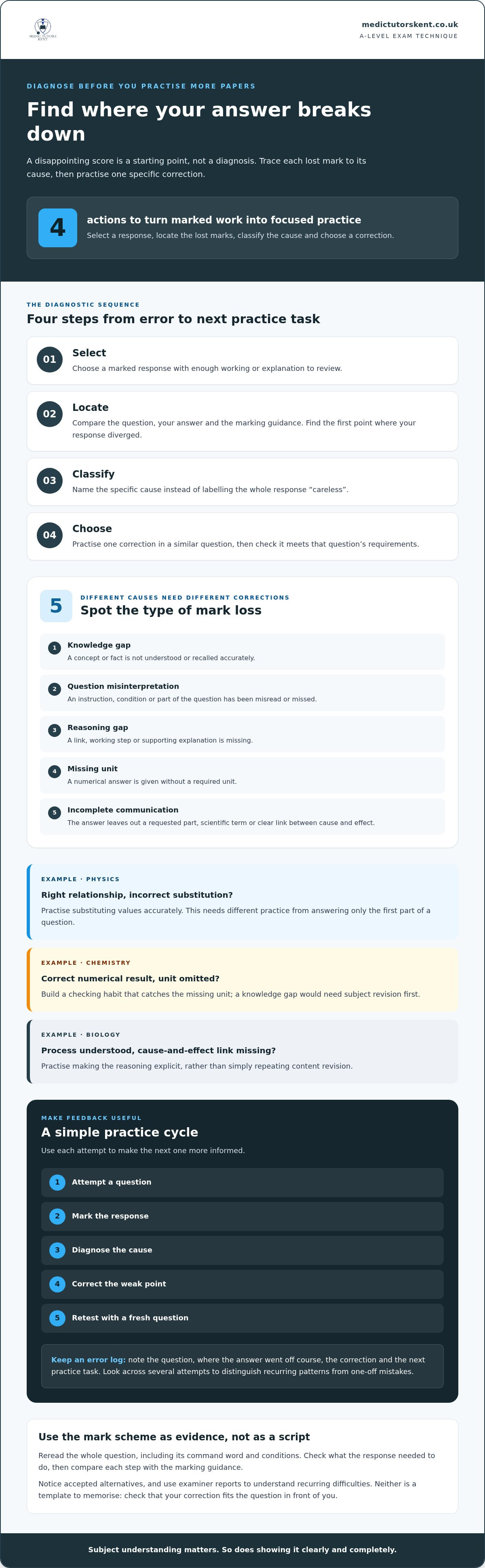
Use this sequence:
- Select a marked response with enough working or explanation to review.
- Locate each lost mark by comparing the question, your answer and the marking guidance.
- Classify the cause: a knowledge gap, question misinterpretation, reasoning gap, missing unit or incomplete communication.
- Choose one correction to practise in a similar question.
Be specific. “I lost marks in physics” is too broad to guide revision. “I identified the right relationship but substituted the values incorrectly” calls for different practice from “I answered only the first part of the question”. In A-level maths and science, a missed unit may call for a checking habit, while a knowledge gap needs subject revision before technique practice can help.
How to analyse a marked A-level answer
Start by rereading the whole question, including its command word and any conditions. Identify what your response needed to do, then compare each step with the mark scheme. Note accepted alternatives rather than treating the scheme as a model script. Mark the first point where your answer diverged. This is more useful than labelling the whole response “careless”.
Use examiner reports as supporting evidence. They can explain recurring difficulties or clarify what an effective response needs to show, while the mark scheme helps you examine the specific question. Neither is a template to memorise: a rehearsed phrase may miss the point when the context changes. Check that your correction meets the requirements of the question you’re practising.
How to separate recurring patterns from one-off mistakes
One lost mark is a clue, not a diagnosis. Review several marked attempts and group errors by cause, topic and response type. If you miss units in calculations across different topics, you may have a broader checking weakness. If an unusual instruction causes one misread, it may be an isolated slip. Prioritise repeated errors, especially those that interrupt an answer or affect several available marks.
A useful exam-error log records the cause, the correction and the next practice task. Keep each entry brief: note the question, explain where your answer went off course, state the adjustment and choose a fresh question to test it. This makes progress easier to review without reducing every practice paper to an unexplained score.
Structured A-level maths and science tutoring can help you analyse marked work and practise targeted corrections when patterns are difficult to identify alone.
Match A-level exam technique to maths and science question types
A reliable response method depends on the task. A calculation needs a clear route from the information given to the result. An explanation needs connected scientific reasoning. An extended response needs a deliberate structure that addresses the precise question. Command words such as “calculate”, “explain” or “evaluate” help you identify the task, but they don’t replace reading the whole question. Check its context, data and any limits on what you’re being asked to discuss.
What changes between calculation and explanation questions?
For a calculation, identify the relationship that fits the quantities, show the substitution and include enough working to make your method clear. Add units where required, then check whether the result is plausible in context. For an explanation, build a coherent chain: state the relevant principle, apply it to the situation and show how it leads to the outcome. In either format, a correct final answer may not show every assessable step, so make your reasoning visible.
How should students approach extended-response questions?
Before writing, identify the focus and organise your points in a logical order. Use precise subject terminology where it adds meaning, not as a substitute for explaining how ideas connect. In evaluation tasks, address the evidence or limitations named in the question. Then check each paragraph: does it advance the requested explanation, comparison or judgement, or is it just a related fact?
Mark schemes and accepted alternatives vary by question and exam board. Use the student’s current specification and relevant board guidance to check subject-specific wording and expectations. Don’t assume a phrase learnt from one answer will always be sufficient. A level exam technique tutoring can help students practise adapting response structures to their curriculum and challenging examination questions, rather than applying one rigid template to every task.
Build a repeatable A-level exam practice routine that fixes weak points
Past-paper practice works best as a feedback loop, not a tally of completed questions. Choose a focused task based on a weakness you have identified, then follow the same sequence each time:
- Attempt the question independently, without opening the mark scheme or a worked solution.
- Mark your response against the relevant scheme. Check how the marks are awarded and where more reasoning or detail is needed.
- Diagnose the cause of any lost marks. Use an examiner report to understand broader patterns in how students approach that type of question.
- Practise one correction, such as showing each calculation step or linking evidence to a scientific conclusion.
- Retest later with a similar question to see whether the correction transfers to a fresh context.
Mark schemes and examiner reports are tools for analysis, not scripts to memorise. Read them after attempting the question so you can see your own reasoning. Look for what makes a response creditworthy, such as relevant steps, precise explanation or a complete conclusion. Then practise applying those features in your own words and to a different question. Completing papers without reviewing errors creates activity, but doesn’t show that a weak point has been fixed.
How to use past papers without turning practice into repetition
Choose a short set of questions that tests a diagnosed weakness before attempting another full paper. If your explanations lack a clear chain of reasoning, target explanation questions. If your calculation working is incomplete, practise questions that require several stages. Attempt each question before consulting guidance. Later, revisit a similar question rather than immediately copying a corrected answer. This tests whether your method holds when the details change.
Keep the routine manageable. Record the correction and retest task in your practice notes, then use the result to decide what comes next. If the same weakness remains, revisit the underlying concept or refine the correction. If it no longer appears, practise it alongside another question type so you can use the skill beyond a single example.
How to manage time and check answers under pressure
Introduce timed practice in stages. First, focus on accurate responses without strict timing. Next, set a realistic time for a small group of questions, allowing for the marks and the work each task requires. As your accuracy and control improve, move on to larger sections and then full papers. Practise moving on when progress stalls, and returning to a question if time remains.
Use any remaining checking time deliberately. Scan for missing units, sign errors, unanswered parts and conclusions that don’t address the task. Check the question’s requirements, not just your arithmetic or spelling. Targeted A level exam technique tutoring can help you apply this practice cycle to A-level maths and science questions. Explore targeted A-level maths and science tutoring for structured support with exam preparation.
When A-level exam technique tutoring can provide targeted support
More practice isn’t always what’s missing. Targeted help may be useful when the same marks keep slipping away despite revision, feedback doesn’t make clear what to change, or you can correct an answer but struggle to apply the correction to a new question. Each signal points to a different issue. Review your work closely rather than simply completing more questions in the same way.
Focused tutoring connects evidence in marked answers to the knowledge and decisions behind them. A tutor can review your work, identify whether the root cause is subject understanding or response technique, teach a relevant method, guide practice and revisit it with a fresh question. For example, a missing step in a maths solution may point to a reasoning or presentation habit, but it could also reveal uncertainty about the method itself. The practice needs to address the actual cause.
What should a focused tutoring session address?
Start with a specific marked response or recurring question pattern, not a general aim to “improve exam technique”. Examine what the question required and where the answer fell short. Link the issue to the relevant maths or science understanding, then model and practise a precise adjustment. Finish with an independent task so you can try the method without prompting, and set a clear point for reviewing that practice.
This keeps the work purposeful. If you struggle to interpret a multi-part question, practise identifying each demand before drafting a response. If a correct calculation loses clarity through omitted working or units, make those steps part of your checking routine. Tailored A-level maths and science tuition can combine subject teaching with exam-response practice, rather than treating them as separate objectives.
How can students and families judge whether the approach is helping?
Look for evidence across comparable practice questions, not just one encouraging answer. Track whether the same error appears less often and whether your working, reasoning and response to the question become clearer. A correction that transfers to a new context is more meaningful than reproducing a model answer. If the error persists, revisit the diagnosis: you may need further teaching, a different practice task or clearer feedback on the next step.
Use a simple record to make progress visible: note the original issue, the correction practised and what happens when you test it again. This gives students and families a practical basis for deciding what to focus on next, without treating every mark as a verdict on ability. Practice evidence can guide preparation, but it can’t guarantee an examination result.
A level exam technique tutoring is most useful when it turns a specific weakness into a clear plan for teaching, practice and review. If recurring exam-response problems are difficult to resolve alone, tailored support can address both A-level subject understanding and the way answers are communicated.
Turn exam feedback into your next focused step
Your next move doesn’t need to be another full paper. Choose one recurring difficulty and focus your next practice session on it. A clear target gives revision direction and helps you judge whether a new approach is working, without treating one result as a prediction of your final grade.
A level exam technique tutoring provides a structured way to work on that target alongside the subject knowledge it depends on. Tailored A-level maths and science tuition supports subject mastery and exam readiness, with one-to-one and small-group sessions. The focus is on understanding your needs and practising the skills required to tackle challenging examination questions.
For structured support with A-level maths and science and a clear focus for your next step, explore tailored tuition with Medic Tutors Kent.
Frequently Asked Questions
Can A-level exam technique be improved without extra tutoring?
Yes. Review marked work and choose one specific behaviour to change in your next practice question. For example, if you often miss the final part of a question, underline each task before answering and check them off before moving on. Keep the adjustment small enough to apply consistently, then assess it across several comparable questions rather than relying on one attempt.
How much past-paper practice should an A-level student do?
There is no single useful amount for every student. The balance depends on how secure the content is and what practice reveals. If you’re still learning a topic, a few carefully selected questions may be more useful than a full paper. Once you can answer accurately, timed sections can test pace and stamina. Leave time to review mistakes: a paper completed but not analysed offers little direction for your next study session.
What is the difference between revision and exam technique?
Revision strengthens recall and understanding of the course; exam technique is how you apply that knowledge to the task in front of you. For example, revising chemistry might mean learning the conditions for a reaction. Technique means recognising when a question requires those conditions and expressing them clearly in the requested format. You need both: technique can’t replace knowledge, and revision alone may not resolve difficulties applying it.
Do A-level exam techniques differ between exam boards?
The core skills are transferable, but question styles, mark-scheme wording and assessment details can vary between boards and specifications. Practise with materials for your own qualification rather than assuming an answer accepted in one paper will meet another board’s requirements. Check the current specification and board materials for subject-specific expectations, particularly for practical or extended-response questions. Use unfamiliar questions to practise adapting rather than memorising a template.
Can exam technique tutoring help if a student is struggling with the subject content?
Yes, when the support addresses the knowledge gap as well as the way answers are constructed. A level exam technique tutoring shouldn’t treat an incorrect explanation as merely a wording issue if the underlying concept is unclear. Tailored A-level maths and science tuition can help you revisit challenging concepts, then apply that understanding to examination questions. The aim is stronger preparation and exam readiness, not a promised grade or result.
How does a tutor identify where an A-level student is losing marks?
A tutor can compare your answers with the question demands and marking guidance, then look for patterns across work from different topics. For example, if your conclusions repeatedly lack supporting evidence, the issue may extend beyond one biology question. Reviewing a range of responses helps distinguish a topic-specific misunderstanding from a habit such as incomplete working or overlooking a stated condition.
When should an A-level student start working on exam technique?
Start as soon as you know enough about a topic to attempt relevant questions, rather than waiting until revision is nearly complete. Early practice can reveal whether you understand a concept and can use it in an examination-style task. Keep the initial focus narrow, then revisit technique as you study new topics and question formats. This builds familiarity steadily and leaves time to address recurring difficulties.
