
A-Level Maths and Science Tuition: 2026 Structured Guide
More practice papers will not fix a concept a student has never properly understood. Effective A level maths and science tuition starts by identifying whether a difficulty comes from a missing foundation, an unfamiliar application or exam technique, rather than simply assigning more questions.
When a student struggles with a difficult topic, it can be hard to tell whether the problem is isolated or rooted in earlier learning. Useful support should reflect the student’s subjects, curriculum and immediate priorities, with progress judged by understanding as well as exam readiness.
This guide explains what well-structured A-level tuition should include and how to assess whether it addresses the student’s learning needs. It covers setting academic priorities, strengthening subject knowledge alongside relevant exam practice, and recognising meaningful progress without relying on promises. It also explains how one-to-one and small-group tuition can support curriculum learning and examination preparation, with each next step grounded in the student’s work.
Key Takeaways
- Choose A level maths and science tuition that reflects the student’s subject, curriculum and current learning priorities.
- Look for a clear learning cycle: set priorities, teach concepts, apply understanding and review progress.
- Compare one-to-one and small-group tuition by considering the learning context and the individual attention needed.
- Track progress through practical evidence, such as clearer explanations, stronger independent reasoning and more confident attempts at questions.
- Medic Tutors Kent provides tailored A-level tuition focused on curriculum mastery, subject comprehension and examination readiness.
A-level maths and science tuition: when does tailored support make a difference?
More questions are not always the answer. If a student repeatedly makes the same error, the cause may be an unclear concept or a gap in earlier knowledge, rather than a shortage of practice. Tailored tuition starts by finding the source of the difficulty. Teaching can then focus on the student’s subject, current understanding and curriculum, instead of repeating a classroom lesson or working through another set of questions without a clear purpose.
This distinction matters across A-level maths and science. A student may need to revisit a foundational idea before a later topic makes sense. Another may understand the content but need to apply it more effectively under examination conditions. Good support distinguishes between these needs and sets lesson priorities accordingly. A-level courses vary by subject and specification; the A-level (United Kingdom) Wikipedia article offers general background, while tuition should reflect the student’s actual course.
What can A-level tuition help a student address?
Unclear concepts can affect several topics. In maths, uncertainty with algebraic manipulation can make later work involving functions or calculus harder to follow. In science, an insecure grasp of a core idea can make it difficult to explain a process or apply knowledge in an unfamiliar context. These challenges can also affect confidence, particularly when a student cannot see why their answers are going wrong.
Start with the specific learning need. Review classwork, questions the student has found difficult and the reasoning behind their answers. Is the concept misunderstood, or is the student struggling to interpret the question? Subject knowledge and examination familiarity are connected, but they are not the same. Tuition can address either or both, without treating every challenge as a gap in content.
Tuition can also benefit students whose current work is secure. Lessons can consolidate complex ideas, test how well the student can apply them and develop more precise explanations. The first step is to establish what would move learning forward, rather than assume a weakness.
Why can maths and science need different approaches?
Mathematics often builds through connected concepts. A student needs to understand the reasoning behind a method, choose it appropriately and apply it accurately. If the underlying principle is unclear, memorising steps may only provide a temporary fix. Focused tuition can identify where the reasoning breaks down and help the student rebuild the route to a solution.
Science also relies on subject knowledge, but students must interpret information, connect evidence to ideas and apply what they know to the question in front of them. The balance varies between subjects and individual needs. A single teaching method cannot address every gap, so support should respond to the skill the student needs to develop.
A level maths and science tuition can strengthen subject understanding and examination readiness, but it cannot guarantee a particular grade or outcome. Its value lies in setting precise priorities, teaching relevant content and helping the student see what they can do independently.
What should effective A-level maths and science tuition include?
Effective tuition follows a deliberate sequence. Rather than moving from one worksheet to the next without checking whether learning is taking hold, each session should connect immediate priorities with subject comprehension and examination readiness. The focus can then change as the student’s understanding develops.
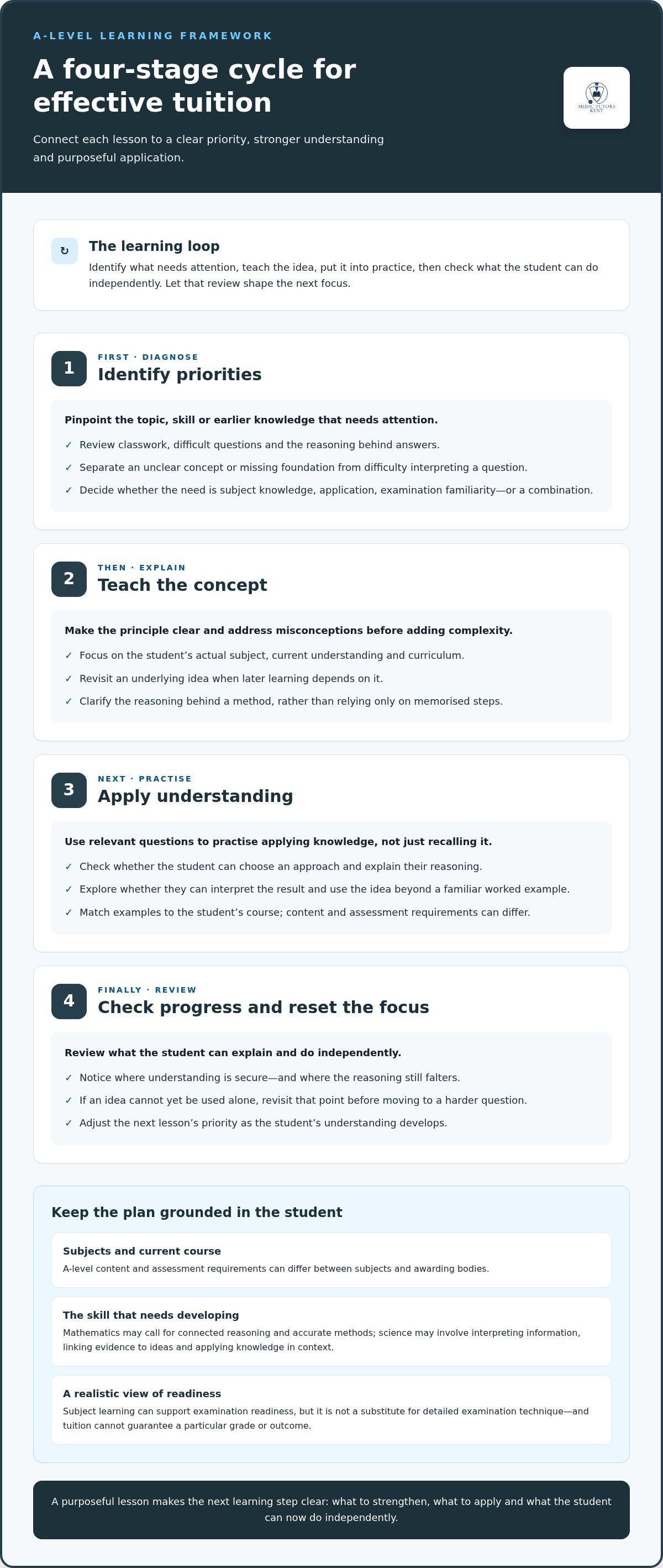
A useful framework has four stages:
- Identify priorities. Pinpoint the topic, skill or underlying knowledge that needs attention.
- Teach the concept. Clarify the principle and address misconceptions before adding complexity.
- Apply understanding. Use relevant questions so the student practises applying knowledge, not just recalling it.
- Review progress. Check what the student can explain and do independently, then set the next focus.
This cycle gives each lesson a defined purpose. If a student can follow an explanation but cannot use the idea alone, moving straight to a harder question may not help. The tutor can identify where the reasoning falters, revisit that point and then test the concept in a different context.
How should subject priorities shape a tuition plan?
Begin with the student’s subjects, current challenges and academic priorities. A useful focus is specific enough to guide a lesson, such as clarifying a difficult concept or strengthening the links between ideas. Trying to cover an entire subject area at once can make it harder to see what the student has understood. Review priorities as learning develops and adjust the plan to keep support purposeful, without tying it to a promised grade.
How should teaching connect understanding with exam readiness?
Concept teaching should help students apply knowledge beyond a familiar worked example. Once an idea is clear, relevant questions can show whether the student can choose an approach, explain their reasoning and interpret the result. Reaching an answer matters, but understanding how it was reached matters too. This is the connection between subject learning and examination readiness, rather than a substitute for detailed examination technique.
Examples should fit the student’s current course. A-level content and assessment requirements can differ between subjects and awarding bodies, so teaching should reflect the specification the student is following. Avoid assuming that every topic, question style or practical context applies to every course. Medic Tutors Kent’s tailored A-level maths and science tuition connects curriculum learning with subject comprehension and examination readiness.
For families looking for support shaped around these priorities, tailored A-level tuition offers a practical next step. A structured plan gives each session a clear purpose, while regular review helps keep teaching aligned with the student’s developing needs.
How do you compare A-level maths and science tuition options?
Compare the teaching process, not the size of a tutor’s promises. Profiles and testimonials can provide context, but they do not show how a lesson responds when a student’s reasoning breaks down. Use the framework below to assess whether tuition fits the subject, curriculum and learning priorities.
| Area | What to look for | Useful indicator |
|---|---|---|
| Subject fit | Teaching relevant to the student’s A-level subject and current learning need. | Explanations address the concept or skill the student is working to understand. |
| Curriculum alignment | Lessons reflect the student’s course and current specification. | Examples and practice are selected for the curriculum being studied. |
| Individual attention | A format that suits how the student learns and participates. | The student has a meaningful opportunity to ask questions and explain their thinking. |
| Progress review | Regular checks of understanding, not simply a record of completed tasks. | Next lesson priorities respond to what the student can explain and apply. |
Look for a clear method: how priorities are set, how understanding is checked and how teaching changes when a student needs a different explanation. This is more informative than a profile claim alone. Treat testimonials as individual experiences, not proof of a particular outcome. No comparison can establish that a specific grade is assured.
Which tutor and teaching format match the student's needs?
Relevant subject knowledge matters, as does the ability to explain ideas clearly. One-to-one tuition centres the lesson on an individual student’s questions and learning needs. Small-group tuition gives students instruction in a shared setting. Neither format is automatically right for every learner. Consider whether the student needs close individual focus or is comfortable learning alongside others. Medic Tutors Kent provides private one-to-one and small-group sessions.
How should curriculum and awarding-body fit be assessed?
Start with the student’s actual course and awarding-body specification. AQA, OCR and Pearson Edexcel are examples of awarding bodies, but their specifications are not interchangeable. Check whether lesson content is matched to the student’s curriculum and whether examples reflect its current requirements. Consult the specification before relying on board-specific claims about topics or assessment.
Use the table to compare A level maths and science tuition against the student’s needs, rather than to rank named providers. A suitable fit is reflected in the alignment between the subject, curriculum, teaching format and review process. These are practical signs of relevant support, not guarantees of examination results.
How can families assess tuition fit and monitor progress?
Assess fit through evidence, not reassurance alone. Before tuition begins, clarify what the student is studying and what they need to do more confidently. Then review whether lessons address that need and whether the student can use what they learn with increasing independence. This gives families a grounded view of progress without turning individual indicators into predictions of a final grade.
What should families establish before tuition begins?
Set out the student’s subjects, curriculum and main areas for attention. Be specific: difficulty understanding a topic is different from needing a broader revision plan or support with examination technique. Agree on realistic learning priorities, such as clarifying a concept or improving the ability to explain a method. These are useful aims; a promised grade is not a sound measure of tuition fit.
How can families review and adjust support?
Use this four-step sequence to keep tuition aligned with the student’s needs:
- Define priorities. Record the subject, current curriculum and specific learning need, using classwork or difficult questions as evidence.
- Align support. Check that tuition addresses the relevant subject and priority rather than following a generic plan.
- Review learning. Look at what the student can explain, reason through and attempt without step-by-step prompting.
- Adjust focus. Keep what is working, revisit unresolved difficulties and set the next priority based on observed learning.
Keep a brief record after sessions. Note the concept covered, the kind of help needed and what the student could do independently by the end. For example, a student might move from following a worked method to explaining why it applies, then attempt a related question without being guided through every step. This offers more useful evidence than a tally of completed exercises alone.
Progress can also show in how a student handles unfamiliar contexts. Can they connect an idea to a new question, explain their reasoning clearly or recognise where they need to check their understanding? These signs help families and tutors identify the next teaching priority. They indicate developing learning, not guaranteed examination performance. One strong session or one difficult test cannot establish the final outcome.
Keep reviews proportionate. Compare work over time, note recurring errors and discuss whether the original priority still matters. If understanding is secure, shift attention; if the same difficulty persists, adjust the teaching focus. A level maths and science tuition should respond to the student’s curriculum and demonstrated needs, rather than follow a fixed sequence regardless of progress.
If a particular maths topic needs attention, explore tailored A-level maths tuition as a practical next step towards focused support.
How can Medic Tutors Kent support A-level maths and science learning?
Once a student’s priorities are clear, support should connect directly to their course and learning needs. Medic Tutors Kent provides tailored private A-level maths and science tuition, with sessions focused on curriculum mastery, subject comprehension and examination readiness. The purpose is not to add tuition for its own sake, but to give the student structured support that fits the subjects they are studying and the areas they want to strengthen.
What does Medic Tutors Kent's A-level tuition focus on?
A-level study calls for secure understanding and the ability to work with ideas in context. Tuition is tailored to the curriculum, helping students develop their grasp of subject content and prepare for examination demands. Memorised information alone may not show whether a student understands an idea well enough to explain or apply it. Sessions can therefore focus on strengthening comprehension and developing a more complete command of the course.
Families can choose between private one-to-one and small-group tutoring sessions. These are different learning formats, not promises of particular outcomes. One-to-one tuition centres on an individual student; small-group tuition takes place in a shared learning setting. Consider which context best matches the student’s needs, priorities and preferred way of engaging with a subject.
Before beginning, families can make the intended focus more precise by identifying:
- The A-level subjects the student is studying.
- The curriculum or specification they are following.
- The topics or skills they currently find challenging.
- Their main priority, such as strengthening subject understanding or preparing for examination demands.
This gives tuition a clear starting point. A student who needs to consolidate subject knowledge may have a different priority from one who wants to develop greater assessment readiness. As understanding develops, priorities can be reviewed and refined.
What is the next step for a student or family?
Start with an honest picture of the student’s current position. Look at classwork, topics that remain unclear and the curriculum they are following. Then identify one or two immediate priorities rather than trying to solve every academic challenge at once. A precise starting point makes it easier to see how tailored tuition relates to the student’s needs.
Medic Tutors Kent’s A level maths and science tuition offers students curriculum-focused support. Sessions are designed to support subject mastery and examination readiness, without promising a particular grade or result. Set a clear priority, choose a suitable learning format and begin with the areas that matter most to the student’s progress.
Explore A-level tuition with Medic Tutors Kent and take the next step towards focused support for the student’s maths or science learning.
Turn clear priorities into focused progress
Move from concern to a practical starting point by choosing the subject that needs attention first. Identify what the student wants to understand or do more confidently, then use that priority to shape support. A clear focus makes it easier to begin constructively and review whether learning is moving in the right direction.
For families considering A level maths and science tuition, the aim is not to predict a result. It is to provide relevant academic support, build confidence through understanding and help the student approach their studies with greater clarity. A plan can begin with one specific challenge and develop as the student’s needs change.
Explore tailored A-level maths and science tuition with Medic Tutors Kent and take a considered next step for your student. With clear priorities and focused support, they can keep working towards their academic goals.
Frequently Asked Questions
Is A-level maths and science tuition worth considering?
Yes, it can be useful if a student’s difficulty is affecting their ability to keep up, complete coursework or approach assessments with confidence. Repeated errors in a topic, for example, may show that a prerequisite needs attention before the class moves on. Tuition is not automatically the answer to a busy timetable: define the issue first, then consider whether focused teaching could address it.
Can a tutor support A-level maths and science at the same time?
Yes, a student can receive support across maths and science. The practical question is how to allocate attention. Identify which subject needs the most immediate focus, then account for the other subject’s priorities too. Reviewing upcoming assessments and difficult areas in each course creates a useful basis for planning, without assuming both subjects need equal attention in every session.
When should a student start A-level maths or science tuition?
Consider starting when a specific difficulty becomes clear, rather than waiting until exam preparation is the only priority. Support may help when a student is struggling to follow a new topic or repeatedly relying on help to complete related work. Tuition can also begin later when the student identifies a particular area to address. Timing depends on the learning need, not a fixed point in the school year.
How many A-level tuition sessions does a student need?
There is no set number that suits every student. It depends on the subject, the nature of the difficulty, available study time and how independently the student can use what they learn. Consider the intended focus and review whether the student can tackle related work with less support. If the priority changes, the plan may need to change too. A fixed session count is not a promise of a particular result.
Should A-level tuition follow the student's exam board?
Yes, tuition should reflect the course and specification the student is studying. Awarding-body requirements can differ, so a resource or example designed for another course may not match the student’s needs. Check the qualification and current specification details before using board-specific materials. Course information and school or college materials can help families keep tuition relevant to the curriculum.
Can A-level tuition guarantee better examination results?
No. Tuition cannot guarantee a grade or examination outcome. It can provide structured teaching to support subject understanding and preparation, but results depend on the student’s learning, independent work and performance in the assessment. Judge support by what the student is learning to do, not by a promised mark. Clear explanations, stronger independent work and the ability to address unfamiliar questions are useful signs of development, not guarantees of a final grade.
