
A-Level Science Revision Support: A Systematic Checklist for 2026
What if the problem isn’t how long you revise, but whether your revision shows you what you still don’t know? Rereading notes can feel productive, yet it won’t tell you reliably whether you can recall a process, apply an equation or explain a result under exam conditions. Effective A level science revision support starts with diagnosis, not guesswork.
It’s understandable to feel unsure which topics are secure, especially when you’re balancing Biology, Chemistry or Physics with other A-level subjects. A repeatable feedback loop can help: identify a gap, practise it, then use the result to decide what needs attention next.
This practical checklist will help you map your confidence by topic, prioritise weak areas and build a realistic routine around active recall and exam questions. You’ll also learn how to review mistakes and recognise when a specific subject gap could benefit from focused academic support. Tailored one-to-one or small-group A-level science tuition offers another way to strengthen understanding and exam readiness.
Key Takeaways
- Distinguish between a topic you’re unsure about and an exam error that keeps recurring. Each points to a different revision action.
- Use a focused cycle of retrieval, checking, correction and review to turn mistakes into clear next steps.
- Choose notes, recall prompts, worked examples or exam questions according to the specific gap you need to address.
- Build a weekly plan that shares your available study time across Biology, Chemistry and Physics, then adjust it using your review.
- Effective A level science revision support helps you spot when independent study is working and when a persistent gap may need more focused guidance.
A-level science revision support starts with a clear diagnosis
Revision becomes purposeful when it identifies a precise gap and directs your next action. Effective A level science revision support isn’t simply more time with notes or a longer list of resources. It’s a structured way to compare what you need to understand with what you can currently explain, recall and apply. The result is a subject-specific plan, not a vague instruction to “revise Chemistry”.
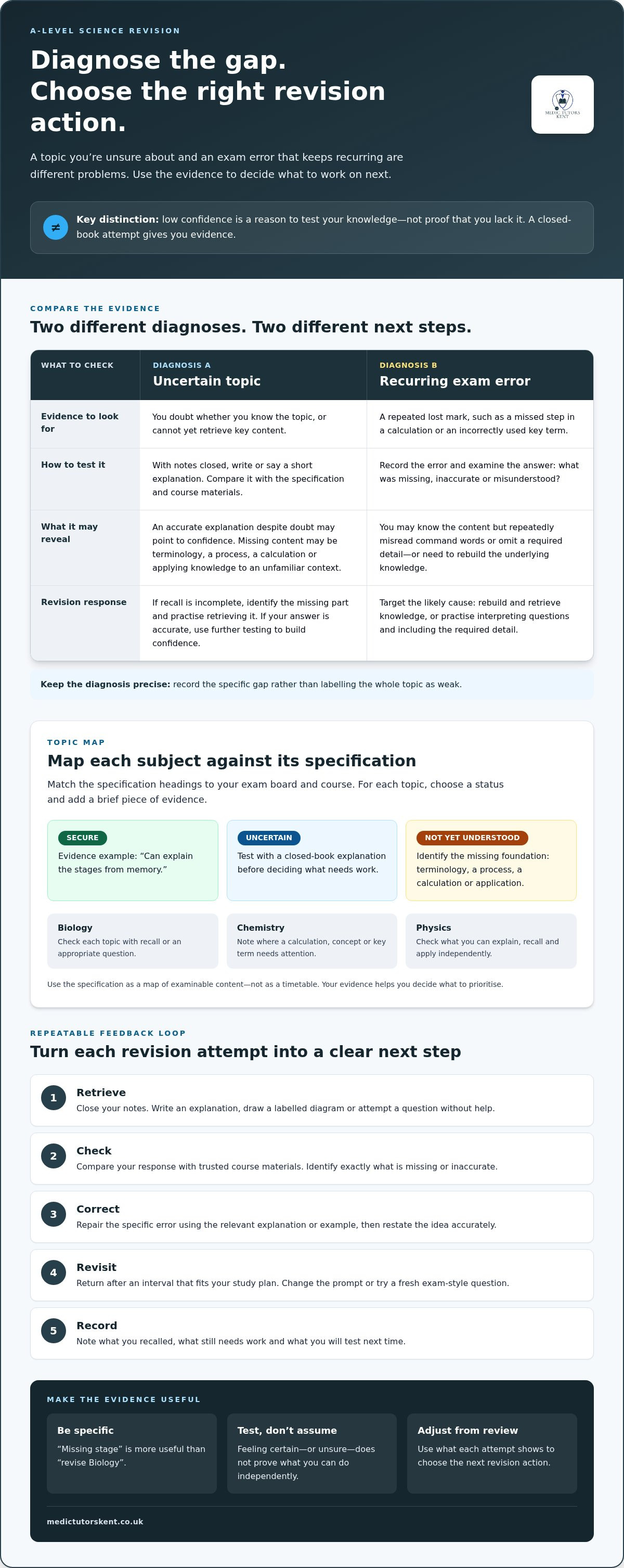
A revision gap is a specific, evidenced difference between what a question requires and what you can demonstrate. Evidence might be an incomplete explanation, a missed step in a calculation or a mark lost because you used a key term incorrectly. A low-confidence topic and a repeated exam error aren’t the same diagnosis, so they shouldn’t trigger the same response.
Use the specification as a map of examinable content, not as a timetable. It shows which topics to account for, but it doesn’t determine how long to spend on each one or what to study first. For a broad introduction to the qualification, see this A-level qualification overview. For revision planning, use your own exam-board specification as the working document.
Map Biology, Chemistry and Physics against the specification
Separate each subject into its specification topics before estimating your confidence. Match the headings to the correct exam board and course, then label each topic secure, uncertain or not yet understood. Add a brief piece of evidence beside each label. For example, “can explain the stages from memory” or “cannot select the correct equation without prompts”. This gives you a baseline you can check and update.
Keep the evidence concise. You don’t need to rewrite the specification or build a perfect revision timetable yet. The aim is to locate where your understanding is strong, where it needs testing and where a foundation is missing.
Distinguish a knowledge gap from a confidence gap
Choose one uncertain topic and write or say a short explanation with your notes closed. Then compare it with the specification and your course materials. If your explanation is accurate but you doubted yourself, confidence may be the issue. If you can’t retrieve key content, identify what’s missing: terminology, a process, a calculation or the ability to apply knowledge to an unfamiliar context.
Treat confidence as a prompt for testing, not proof of mastery. Feeling certain doesn’t show that you can answer independently, and feeling unsure doesn’t prove that you can’t. A closed-book attempt gives you evidence to guide your next step.
Classify errors as carefully as topics. If you can’t recall a biological process, you need to rebuild and retrieve that knowledge. If you explain it accurately but repeatedly misread command words or omit a required detail, examine how you interpret and answer questions. Record the error and its likely cause rather than marking the whole topic as weak. That distinction gives your next revision session a clear purpose and makes progress easier to measure.
Build an A-level science revision system that strengthens recall
Once you’ve chosen a topic, use the same sequence each time: retrieve, check, correct, revisit and record. This turns revision into a feedback loop. You test what you can produce independently, compare it with accurate course material, repair specific omissions and return later to see what has stuck. A level science revision support is most effective when each step has a clear purpose, rather than when a session becomes an unplanned cycle of reading and highlighting.
Retrieval practice tests what you can access from memory; rereading mainly presents the information again. Both can have a place, but start by making your knowledge visible. Keep each session narrow enough to act on: focus on one process, calculation type or concept, not an entire subject.
- Retrieve: Close your notes and write an explanation, draw a labelled diagram or attempt a question without help.
- Check: Compare your response with trusted course materials. Identify exactly what’s missing or inaccurate.
- Correct: Repair the error by working through the relevant explanation or example, then restate the idea accurately.
- Revisit: Return to the topic after an interval that fits your study plan and test it again.
- Record: Note what you recalled, what still needs work and what you’ll test next time.
Use active recall before reopening notes
Begin with a blank page. For example, explain a biological process in sequence, draw and label a cell structure, or attempt a Chemistry calculation unaided. Then check your response against your course materials. Don’t write “revise this again”; specify the omission, such as a missing stage, incorrect unit or imprecise term. Turn that point into a short question or prompt for your next recall check.
Revisit difficult topics with a deliberate sequence
Plan another attempt after an interval that suits your timetable and how secure your first attempt felt. If you needed substantial help, return sooner in your plan. If you recalled the main ideas accurately, leave a longer gap before testing again. Change the prompt each time: explain the concept in a new way, apply it to a different example or try a fresh exam-style question. This helps you check understanding beyond memorised wording.
Keep the record brief and factual. Write what improved, what remains uncertain and the next action. For instance: “Can now explain the stages; still confuse the conditions affecting the rate.” That note gives your next session a defined starting point and makes progress easier to judge than a list of hours studied.
If a specific topic remains difficult despite this cycle, focused guidance can help clarify the explanation and provide a structured check of your understanding. Tailored A-level science tuition can support you as you strengthen subject understanding and exam readiness.
Choose A-level science resources by the gap you need to solve
A resource is useful when it addresses the problem you’ve identified. If you can’t explain a process, another past paper may not help yet. If you understand the topic but struggle to apply it, rereading notes is unlikely to show whether you can transfer that knowledge. Choose a resource that targets the missing skill, then check whether it has resolved the gap.
- Concise notes: Clarify an explanation that remains incomplete after an unaided recall attempt. Focus on the missing concept, not another full chapter reread.
- Recall prompts: Test whether you can retrieve a definition, sequence or equation without looking. Rewrite prompts that only test recognition.
- Worked examples: Follow the steps in an unfamiliar calculation, including why each equation or operation is used, before trying a similar problem independently.
- Exam questions: Test whether you can select and apply knowledge in a particular question context, including unfamiliar scenarios.
Keep your resource set compact: the relevant specification, concise course notes, a small collection of recall prompts and suitable exam questions with mark schemes. A larger library can create the appearance of progress without improving recall or application. Choose your next resource by asking: what, precisely, could I not do in my last attempt?
Match the resource to the problem
Use notes to repair a specific misunderstanding, then close them and explain the point again. For a calculation, study a worked example to understand the logic behind each step. Then cover it and attempt a comparable question unaided. Use exam questions when you’re ready to test whether your knowledge transfers. If you can answer only when the method is obvious from your notes, you haven’t yet tested independent application.
Review practice answers against the right standard
Attempt the question independently before opening the mark scheme. Then compare your answer with the required scientific points, not just the final mark. Identify whether you omitted a key detail, used imprecise terminology, misunderstood the command word or took an incorrect calculation step. Record the cause and correct the underlying point. Copying a model answer may produce a polished response, but it won’t show whether you can reproduce the reasoning yourself.
Check that practice papers and specification materials match your exam board and course. A question from another board may still help you practise a concept, but its wording, emphasis or expected answer structure may differ. Use your own board’s materials as the reference point for exam practice and mark-scheme review.
For A level science revision support, make every resource choice traceable to an observed need: name the gap, select a tool, attempt the task and note what the result shows. This simple filter prevents collecting resources from replacing deliberate practice.
Use this weekly A-level science revision checklist to adjust your plan
A weekly plan should respond to evidence, not dictate an unrealistic workload. Use your topic notes and practice results to decide what needs attention, then fit those tasks around lessons, homework, other subjects and rest. The aim isn’t to fill every free hour. It’s to make deliberate progress across Biology, Chemistry and Physics without allowing one difficult topic to consume the whole week.
Plan a manageable revision week
Choose a small number of priorities from your diagnostic notes. Give every revision session one defined task, such as recalling a process, correcting a calculation method or attempting exam questions. Share attention across your sciences according to course demands and current gaps, rather than dividing time equally by default. Leave space for unfinished work and unexpected changes. A plan that can adapt is more useful than one that collapses after a missed session.
Before the week begins, check upcoming lessons, school deadlines and other commitments. Then use this checklist to shape the available study time:
- Select priorities: Choose topics with clear evidence of difficulty or an upcoming course need.
- Set a task: Specify what you’ll produce, such as a closed-book explanation or a set of targeted questions.
- Balance subjects: Include Biology, Chemistry and Physics in a way that reflects your individual demands and available time.
- Protect flexibility: Keep space to revisit unresolved material, complete schoolwork or move a task if plans change.
- Include review: Reserve time to check what your attempts show, rather than measuring the week only by hours studied.
Make each entry concrete. “Chemistry revision” is difficult to start and impossible to evaluate. “Explain the topic from memory, then attempt questions on the parts I missed” gives you a clear action and a result to review.
Close the week with an evidence-based review
At the end of the week, record which tasks you completed and which topics need another attempt. Compare your latest response with an earlier one: is the explanation more complete, the method more accurate or the application less dependent on prompts? Note the specific change, not simply whether the session felt successful. If you missed a task, carry it forward deliberately or replace it with a more urgent priority.
Use that review to set the next week’s priorities. A topic that has improved may need a fresh check later; a repeated error may need a different resource or explanation. This is the working discipline behind A level science revision support: plan, test, review and adjust without treating a timetable as proof of progress.
If a particular science gap keeps resisting independent revision, explore tailored A-level science tuition for focused support with subject understanding and exam readiness.
When A-level science revision support from a tutor can add focus
Independent revision can work well when you can identify what’s missing, choose a useful next step and judge whether your response improves. Needing more support isn’t a sign of failure. It may mean that a persistent problem needs a clearer explanation or a more structured way to practise. A level science revision support from a tutor can help focus attention on the specific barrier, rather than adding more general revision to an already busy plan.
Recognise when independent revision has reached a limit
Look for patterns in your revision record. The same concept may remain unclear after focused attempts, your explanations may still omit essential ideas, or progress on practice questions may have stalled. Before choosing a response, separate a content misunderstanding from difficulty interpreting a question. You might understand a process but misread what a question asks you to compare. The distinction matters because one issue needs subject clarification, while the other needs targeted question practice.
- Repeated unresolved errors: You keep making the same mistake after reviewing and practising it.
- Unclear explanations: You can’t explain the reasoning or connect the steps without relying heavily on notes.
- Stalled progress: Your attempts aren’t resolving the gap, and you’re unsure what to change next.
Use your notes to pinpoint the issue before seeking help. Record the topic, the task you attempted and where your reasoning broke down. “I struggle with Physics” is too broad to guide a useful discussion. “I can select an equation but can’t rearrange it correctly” gives you a precise starting point.
Turn identified gaps into focused academic support
Medic Tutors Kent provides tailored A-level science tuition to build subject understanding and exam readiness. Sessions are available one-to-one or in small groups. A clear record of what you’ve tried helps focus support on the specific topic, explanation or question approach that remains difficult, rather than starting from a vague sense that the whole subject needs revisiting.
Bring a recent question attempt, your working and the mark scheme, alongside the relevant specification topic. These materials make the difficulty easier to locate: perhaps a scientific idea is insecure, a calculation step is unreliable or the question wording has been misinterpreted. Use that evidence to guide the next stage of revision, then continue checking your understanding independently. Tuition can add structure and subject-specific guidance, while your own practice remains central to building exam readiness.
If a persistent A-level science gap would benefit from focused guidance, explore A-level science tuition with Medic Tutors Kent.
Make your next revision decision with confidence
Your next step doesn’t need to be a complete overhaul. Choose one unresolved point from your revision record and decide what would help you move it forward: a clearer explanation, guided practice or another way to test your understanding. That decision keeps A level science revision support focused on the barrier in front of you, rather than adding more work without direction.
If you’d value a structured conversation about a subject-specific challenge, explore tailored A-level science tuition. A clear starting point can help focus support on what you need to understand and practise. Take the next step at a pace that fits your circumstances. With a defined question and a willingness to act on feedback, you can approach revision with greater clarity and purpose.
Frequently Asked Questions
Can I revise A-level Biology, Chemistry and Physics in the same study session?
Yes, if you give each subject a distinct task and avoid constant switching. For example, use one block to recall a Biology process, another to practise a Chemistry calculation, then finish by correcting a Physics question. Keep the materials for each subject separate and note what each task revealed. If the Chemistry calculation takes longer than planned, adjust the remaining work rather than rushing through three subjects without learning from any of them.
How long should I revise A-level science each day?
There’s no single daily duration that suits every student. Choose an amount of focused work that fits around lessons, homework, rest and other commitments, then make each session specific. Identify the topic, the task and how you’ll check your answer before you begin. If your A level science revision support plan regularly feels impossible to maintain, reduce its demands and reassess it. A sustainable routine is more useful than an ambitious timetable that repeatedly breaks down.
Should I make my own A-level science revision notes?
Make notes when they solve a defined problem, such as organising the stages of a process you keep mixing up. Keep the result brief: a sequence, labelled diagram or comparison table may be enough. Don’t copy whole textbook sections. Once you’ve made the summary, put it aside and explain the idea in your own words. If you can’t, use that difficulty to decide which part needs further clarification before adding more notes.
What should I do if my A-level science course has few past papers?
Start with your exam board’s current specification and any specimen assessment materials for your course. Use relevant questions in your class materials or topic tests, then practise explaining the science behind your answers, not only selecting a response. If you find an older paper, check its topics against your current specification before using it. A paper that covers content you haven’t studied may not give a fair picture of your preparation.
Can I use GCSE science resources for A-level revision?
Yes, selectively, when a GCSE concept is blocking your understanding of A-level work. For example, revisit a foundational idea in Chemistry if you need to secure it before tackling a more advanced explanation. Then return to your A-level notes and questions. GCSE resources can help refresh prerequisite knowledge, but they won’t cover the depth, terminology or application expected in your current course. Use them to repair a specific foundation rather than as your main revision material.
How should I revise required practicals for A-level science?
Learn what each practical investigates and why its method produces useful evidence. Practise explaining how variables are controlled, what measurements are taken, where uncertainty or error could arise, and how results support a conclusion. Don’t memorise a sequence of actions without understanding what the measurements show. Use your course materials to identify the practical content relevant to your specification, then practise applying the underlying science to questions about methods or results.
For focused A-level science revision support, explore tailored tuition with Medic Tutors Kent.