
GCSE Exam Technique Tutor for Teenagers
Board-specific preparation matters: a GCSE exam technique tutor should use the student’s exam-board specification to focus revision on the material assessed. Practising with relevant papers then helps them apply their knowledge, check answers and structure responses clearly. Exam technique isn’t a generic set of tricks; it’s a repeatable method tailored to the paper.
It’s reasonable to wonder whether a teenager needs tutoring or simply more revision. The distinction matters. If they know the content but lose marks through incomplete working, unclear explanations or answers that don’t address the question, the issue may be how they apply their knowledge under exam conditions.
This article explains how board-specific preparation works, how estimation can help spot possible errors, and how mark schemes can clarify what longer answers need to include. It also covers signs that extra support may help, what exam technique tutoring can address, and how to choose a practical next step for your teenager.
Key Takeaways
- Use the relevant exam board specification to focus revision on the content your teenager will be assessed on.
- Teach them to estimate answers and check whether results make sense, especially in science questions.
- Use mark schemes to show how to organise working and build clear, focused long answers.
- Once most subject content is secure, make past-paper practice a central part of preparation.
- Look for recurring difficulties, such as knowing the material but losing marks when applying it, to judge whether targeted support could help.
Are the GCSE Exam technique courses exam board specific?
Yes. GCSE exam technique should be practised against the student’s subject specification and exam board, so revision targets the material assessed in their papers. The specification provides the framework; a tutor can then connect each topic to question styles and marking expectations in relevant papers.
Subject knowledge comes first, but knowing the content alone doesn’t secure every available mark. A student may understand a physics principle yet lose credit by omitting a unit, skipping a calculation step or failing to explain a cause. A useful tuition session identifies the specific gap, then practises a more precise response using the student’s specification and exam materials.
Board-specific preparation matters because GCSE papers often use familiar formats and precise marking criteria. These patterns are worth learning, but they’re no reason to memorise answers. If a new specification has few past papers, students can practise with the exam board’s specimen or mock papers, then compare their approach with the relevant mark scheme.
Assess subject and exam-board suitability separately. A tutor may be strong in GCSE maths but less suited to a teenager’s chemistry course or a particular paper format. Match the tutor’s subject specialism to the GCSE being studied, then use the correct specification to organise revision. For combined science, check that practice covers the student’s course and its biology, chemistry and physics content.
For an effective first session, bring a recent marked paper, the specification and examples of questions that caused difficulty. The tutor can group errors into categories: missing knowledge, misread command words, incomplete working or poor timing. This diagnosis helps determine whether the next step is subject teaching, technique practice or a combination of both.
GCSE subject choices also shape preparation. A teenager taking separate sciences needs focused practice across biology, chemistry and physics; someone studying maths alongside science may need different approaches to calculations and written explanations. A GCSE exam technique tutor should make each subject’s question demands clear, rather than applying one generic template to every paper.
Online and in-person tuition can both support board-specific practice. Online lessons make it easy to work through digital papers and annotate answers; in-person sessions let tutor and student review printed work together. The key factors are access to suitable materials, concentration and how the teenager learns best.
Ask a tutor to cover the exam board’s instructions, question command words, mark allocations and assessment objectives for the relevant subject. For example, a response to “compare” needs clear points of comparison, whilst a calculation should show a coherent method as well as its answer.
The cost depends on subject, tutor expertise, session format and the level of preparation required, with the price given after a quote request. To find a GCSE exam technique tutor near you, narrow the search by local area, subject and exam board; online tuition removes the need to be nearby.
There’s no fixed number of sessions needed to improve exam technique. The right sequence depends on errors in marked work, the teenager’s subject knowledge and how consistently they apply feedback during revision and timed practice.
Checking answers through estimation
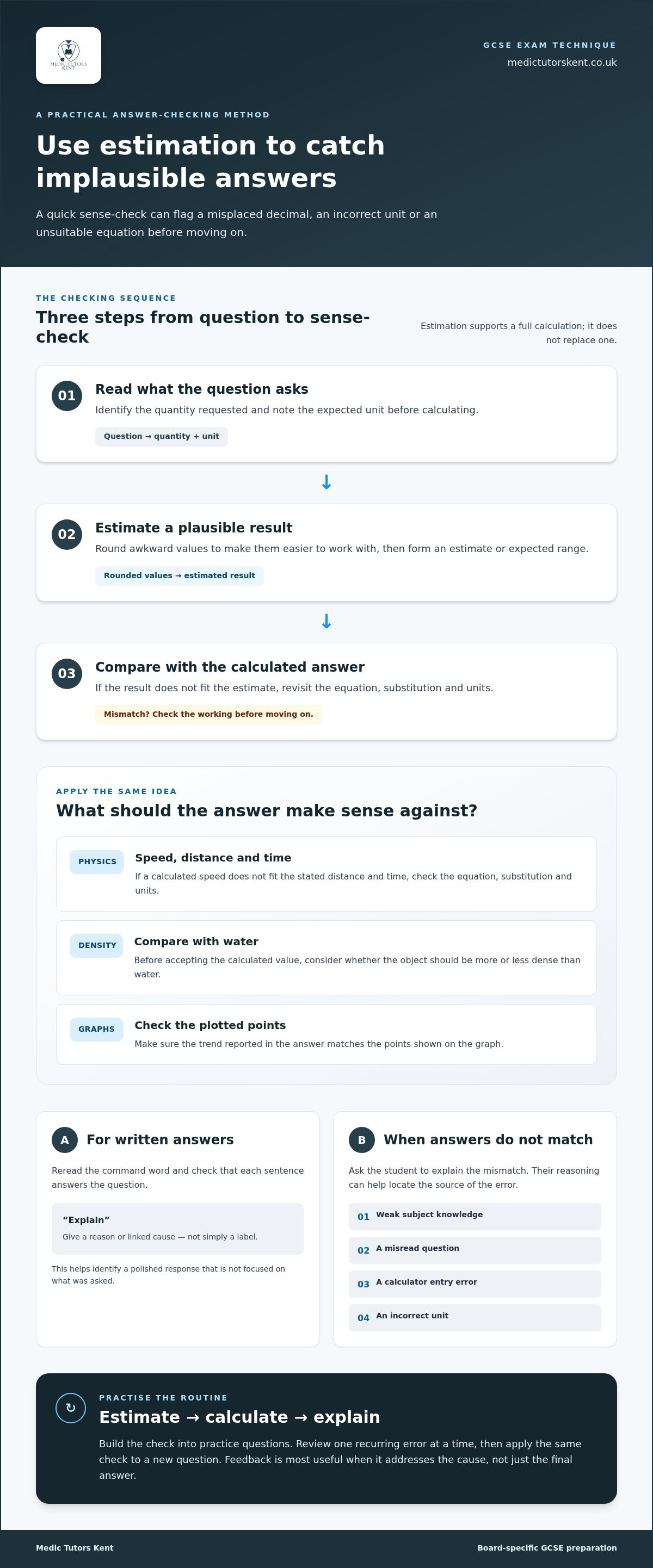
Estimation gives a GCSE student a quick way to check whether an answer is plausible. It’s especially useful in science exams, where an incorrect unit, misplaced decimal point or unsuitable equation can produce an unreasonable result. Estimation doesn’t replace a full calculation; it helps catch errors before the student moves on.
Teach a consistent checking sequence. First, identify what the question asks and note the expected unit. Next, round awkward values to make them easier to work with and estimate the result. Finally, compare the estimate with the calculated answer. If a physics calculation produces a speed that doesn’t fit the stated distance and time, revisit the equation, substitution and units.
Estimation also helps check whether the chosen method fits the concept. In a question about density, for example, the student can consider whether the object should be more or less dense than water before accepting a calculated value. In a graph question, they can check whether the reported trend matches the plotted points. These checks connect subject knowledge with exam skills.
A tutor can build estimation into practice questions rather than leaving it until the end. Ask the student to state an expected range, complete the calculation, then explain any mismatch. Their explanation can reveal whether the error came from weak knowledge, a misread question, a calculator entry or an incorrect unit. GCSE tuition is most useful when feedback addresses the cause, not just the final answer.
English offers a similar check for written responses. Ask the student to reread the command word, then see whether each sentence answers the question. For example, a response to “explain” needs a reason or linked cause, not simply a label. This check can prevent a polished but irrelevant answer.
Choose a tutor whose subject expertise matches the work being reviewed. A maths calculation and a chemistry explanation need different concepts, vocabulary and checking routines. In an initial lesson, a marked paper can show whether the student needs more subject teaching or a reliable final-check process. Review one recurring error at a time, then apply the same check to a new question.
Tutor vetting should consider academic fit and safeguarding information. Families may encounter the term Enhanced DBS check; note what documentation is presented and its date as part of a careful review. A check alone doesn’t show whether a tutor can explain GCSE physics, teach estimation clearly or give useful feedback. Assess subject knowledge and teaching approach separately.
For a practical trial, choose a question the student has already attempted. Have them estimate first, calculate second and explain the comparison aloud. This short routine makes their reasoning visible and gives the tutor a precise basis for the next lesson.
Breaking down and structuring long-answer questions
A long GCSE answer needs a clear line of reasoning, not a collection of disconnected facts. Start with the command word, such as “explain”, “compare” or “evaluate”. It tells students what the examiner expects. Then break down the question into its subject, focus and any evidence or context it provides. In a physics question about insulation, for example, identify what needs explaining and which material or conditions the question names.
Mark schemes help students understand how to show working and phrase answers. Use them as a guide to the required detail, not as a script to memorise. Compare the student’s response with the mark scheme and identify where the reasoning breaks down: perhaps a key concept is missing, evidence isn’t linked to the claim, or the conclusion doesn’t answer the question. This turns exam preparation into a specific task.
A simple planning sequence can make a complex prompt manageable:
- Underline the command word. Decide whether the examiner wants an explanation, comparison or judgement.
- Circle the subject terms. Identify the process, concept or evidence that must appear.
- Arrange the response. Put points in a logical order, such as cause, process and result.
- Check each sentence. Link it to the question and remove unsupported claims.
For a science explanation, a student might connect a change in conditions to particle behaviour, then state its effect. Each sentence should advance that chain. In English, a student analysing a character can make a point, select a relevant quotation and explain how a word shapes meaning. The subject changes, but linking evidence to reasoning remains useful.
Students should distinguish command words carefully. “Describe” asks for relevant features; “explain” requires linked reasons. “Compare” means giving direct similarities or differences, not two separate descriptions. For “evaluate”, students need to weigh evidence and reach a reasoned judgement. Practising these distinctions across subjects helps prevent answers that show knowledge but miss the task.
Exam-board materials give preparation the right framework. Students can use the relevant specification, specimen papers or past questions, then compare their responses with the mark scheme. The examiner needs to see the reasoning clearly. A long paragraph can hide a strong idea, so separate distinct points and use precise subject vocabulary.
After marking, rewrite one incomplete answer instead of simply reading the correction. For example, add the missing link between evidence and conclusion, then explain why the revised version answers the question more directly. This repeatable review method helps students turn feedback into a skill they can use on a new question.
Building confidence and improving grades
Confidence grows from evidence of progress, not repeated predictions about grades. Track a teenager’s performance by error type: missed knowledge, misread wording, incomplete working or rushed checking. If the same error appears in several marked questions, make it the next learning target. This gives each revision session a clear purpose and helps the student see whether their method is improving.
Once a student has learnt most of the subject content, past-paper practice should become the main part of preparation. Use a paper from the relevant exam board, mark it against the mark scheme, then record errors by topic and cause. For example, a chemistry answer may show secure knowledge but lose credit because the student doesn’t link evidence to the conclusion. Practise that specific link before attempting another question.
How can you assess whether a GCSE tutor is effective? Look for a clear diagnosis, tailored lesson objectives and feedback that shows what the student should do differently next time. Compare marked work over time for fewer repeated errors, clearer explanations and more independent use of exam methods, rather than relying on confidence or one result alone.
Build a short review loop around each paper:
- Identify the pattern. Select one recurring issue, such as incomplete explanations in biology.
- Practise the correction. Model a stronger answer, then ask the student to apply the same method to a new question.
- Check independence. Review a later response to see whether the student can use the technique without prompting.
A student’s confidence can improve when progress becomes visible in specific subjects. One student reported taking lessons from a GCSE tutor for a couple of months and making significant progress in Biology, Physics and Chemistry. That account illustrates the value of focused support, but the useful measure for another teenager is their own work: clearer reasoning, more secure concepts and fewer repeated mistakes.
Exam preparation also depends on sustainable routines. During exam season, students are advised to take breaks, exercise, eat healthily and maintain a routine. Make those actions part of a practical weekly plan: alternate focused revision with rest, include movement, and keep sleep and meals consistent. A tired student may struggle to apply knowledge they otherwise understand.
Keep the target precise. Instead of asking a teenager to “revise science”, set a task such as correcting one weak response on energy transfer, then explaining the improved reasoning aloud. A tutor can help distinguish a content gap from an exam-method issue, so effort goes where it can make a difference. Review the next marked answer against the same target; applying feedback consistently is stronger evidence of learning than completing a worksheet alone.
Assessing whether a teenager needs a GCSE tutor
A low mark alone doesn’t identify the problem. Compare a recent school assessment with the teenager’s classroom work and a marked practice paper. If biology answers show secure knowledge in class but repeatedly miss key points under exam conditions, investigate whether timing, question interpretation or recall is limiting performance.
Look for a pattern across topics, not just one difficult lesson. A student struggling with several chemistry calculations may need to revisit core concepts. A student who knows the method but omits working may need structured exam practice. Identify the cause before deciding whether private tuition is the right support.
Parent survey figures indicate that 36% cited their child falling behind at school as a reason to seek tutoring, whilst 30% cited not having the knowledge to help. These figures point to two different needs: rebuilding subject foundations and providing focused support beyond what a parent can comfortably teach.
Use this short review to locate the difficulty:
- Check marked work. Note whether lost marks come from missing knowledge, incomplete explanations or misread questions.
- Compare settings. Ask whether the same topic is easier in classroom discussion than in timed practice.
- Review the response. Have the teenager explain one incorrect answer and identify what they would change.
- Choose the intervention. Match the problem to subject teaching, exam-method practice or a combination.
A tutor is most useful when the obstacle is identifiable and recurring. For example, if a teenager can explain a biology process aloud but can’t organise it into a written answer, practise turning each stage into a clear sequence. If they can’t explain the process at all, address the underlying topic before drilling exam technique.
Consider the teenager’s response as well as their grades. Repeatedly avoiding a particular topic, leaving questions blank or losing confidence after an assessment can signal a gap worth investigating. Discuss specific examples calmly. A targeted plan should define what to practise, how feedback will be used and what evidence will show progress.
Extra tutoring may not be the first step if one assessment reflects a temporary misunderstanding. Ask the school teacher which topics need attention, then compare that feedback with the student’s marked work and revision habits. A consistent pattern across classwork and practice papers makes the case for additional structured support clearer.
If the evidence points to a subject or exam-technique gap, review tailored GCSE support options and choose the next step around the teenager’s specific needs.
Medic Tutors Kent: A-level maths and science tutoring
Medic Tutors Kent provides GCSE maths and science tutoring for teenagers who need support with subject knowledge, alongside A-level maths and science tutoring for students preparing for the next stage. If marked work shows recurring gaps in GCSE maths or science, focused tuition can help address those topics and strengthen exam preparation.
For students considering medicine, Medic Tutors Kent also offers UCAT tutoring and medicine application tutoring. These support different stages: GCSE and A-level subject learning, admissions-test preparation, and guidance through the medicine application process.
Identify the immediate need first. A teenager who struggles with physics calculations may benefit from GCSE science tuition; a student moving into sixth form may need A-level subject support. Contact Medic Tutors Kent to discuss the right tutoring.
Turn exam feedback into a focused next step
The next step is to turn one recurring difficulty into a clear plan. Choose a recent paper, identify where marks were lost, and decide whether the priority is subject knowledge, written responses or applying methods under exam conditions. A GCSE exam technique tutor can help target that gap, while regular practice gives your teenager a way to apply feedback independently.
Medic Tutors Kent offers GCSE maths and science tutoring, A-level maths and science tutoring, and UCAT tutoring. Choose support that matches your teenager’s current subject and academic direction, rather than adding lessons without a defined purpose.
To discuss the most relevant next step, contact Medic Tutors Kent. A precise plan can make revision more purposeful and help your teenager approach their next challenge with greater confidence.
Frequently Asked Questions
What does a GCSE exam technique tutor teach?
A GCSE exam technique tutor teaches students to make their subject knowledge clear and relevant under exam conditions. This can include managing time according to marks, choosing which question to tackle first, and avoiding answers that add information but miss the task. For example, a student can practise deciding how much detail a six-mark response needs, then check whether each sentence contributes directly to the answer.
How can a tutor improve GCSE exam technique and grades?
A tutor can identify recurring weaknesses and set focused practice to address them. For example, if a student regularly leaves the final question blank, they can practise moving on from a difficult item and returning to it later. Review progress through marked work, noting whether the student completes more questions and applies feedback independently. Stronger technique can help students access marks, but grades also depend on subject knowledge and performance on the day.
What qualifications and experience should a GCSE tutor have?
Look for strong knowledge of the GCSE subject and experience teaching the relevant level and exam-board specification. A tutor should explain difficult concepts clearly, diagnose why an answer lost credit, and give the student a specific task for improvement. Ask how they would approach a sample question from the teenager’s course. Their explanation should be accurate, structured and suited to the student’s current understanding.
Which GCSE subjects benefit most from exam technique tutoring?
Exam technique can help in any GCSE subject where students need to apply knowledge to specific question formats. Maths and science often involve showing working, interpreting information or connecting evidence with an explanation. English can benefit from focused practice in selecting evidence and supporting an interpretation. The priority is the student’s actual difficulty, not a subject’s reputation: review marked work to see whether marks are lost through knowledge gaps or response methods.
How much does a GCSE exam technique tutor cost in the UK?
The cost depends on the subject, tutor expertise, session format and preparation required.