
Struggling with A-Level Maths? Find the Cause and Build a Clearer Route Forward
More revision is not always the answer. If you’re repeatedly stuck on unfamiliar, multi-step questions, the cause may be a specific gap in your understanding, not a lack of effort. A search for “struggling with A level maths tutor” often begins with a more useful question: what is actually holding your progress back?
It’s frustrating to put in the hours and still feel unsure what to tackle next. Gaps in algebra, calculus or another topic can make new material harder to follow. Repeating questions is unlikely to help much if you’re not also identifying why an answer went wrong.
This article will help you pinpoint the knowledge and problem-solving gaps affecting your work, decide what to practise first and review mistakes more productively. You’ll also see how tailored A-Level Maths tuition can connect understanding with challenging exam questions. Start by diagnosing the cause, then strengthen the right foundations and build towards exam readiness.
Key Takeaways
- Treat repeated difficulty as a diagnostic signal, not a verdict on your mathematical ability.
- Review marked work and notes to spot whether mistakes stem from recall, method choice, execution or interpretation.
- Match your next step to the gap: focused independent practice, school support or private tuition.
- Use short practice cycles to revisit prerequisites, apply a method and learn from errors before reassessing.
- If you’re searching for a “struggling with A level maths tutor”, look for tailored support that connects complex concepts with challenging exam questions.
Why A-Level Maths can feel difficult, and what struggling really signals
A-Level Maths can feel like a sharp step up. Questions may take longer to interpret, ideas can arrive at a faster pace, and a familiar technique may no longer be enough on its own. Finding the course difficult is not a verdict on your ability. It is a signal to investigate what is creating friction, rather than simply adding more revision hours.
A learning gap is a specific prerequisite or problem-solving process that isn’t yet secure enough to support the next step. It might be a forgotten algebraic rule, uncertainty about which method applies, or difficulty explaining what an answer means. Each cause calls for a different response.
- Content: a definition, formula or earlier idea is unclear or hard to recall.
- Application: you know a method but can’t recognise when or how to use it.
- Pace: new material is moving on before previous steps have settled.
- Interpretation: the wording or context of a question makes it difficult to identify what is being asked.
What changes when students move from GCSE to A-Level Maths?
At GCSE, practice may often centre on recognising a familiar question type and applying its procedure. At A-Level, a question can require you to select and combine methods, sometimes in a context you haven’t seen before. The course spans Pure Mathematics, Statistics and Mechanics; an overview of A-Level Mathematics shows the breadth of content and skills involved.
These areas build on earlier ideas. Difficulty rearranging an equation, for instance, can obstruct work on a more advanced topic even when the new concept itself makes sense. The transition feels different for each student, depending on which foundations are secure and where more practice is needed.
Does struggling mean you are not suited to A-Level Maths?
No. A current mark or a run of difficult questions describes performance at a particular point; it does not establish a fixed limit on what you can understand. Frustration is understandable, especially when effort doesn’t seem to translate into progress. Effort alone cannot guarantee a particular grade, and repeating the same practice without examining the errors may leave the cause untouched.
Identify the cause before you change the plan. Look for the point where the work breaks down: recalling a fact, choosing a method, carrying it out accurately or interpreting the result. That evidence gives you a clearer next step than labelling yourself “bad at maths” or assuming that more questions must be the answer.
If you’re searching for a “struggling with A level maths tutor”, begin with that diagnosis. Tailored tuition can help identify specific learning needs and connect understanding of complex concepts with practice on challenging examination questions. First establish what the difficulty is telling you, then choose a response that targets it.
Diagnose the A-Level Maths gaps behind repeated mistakes
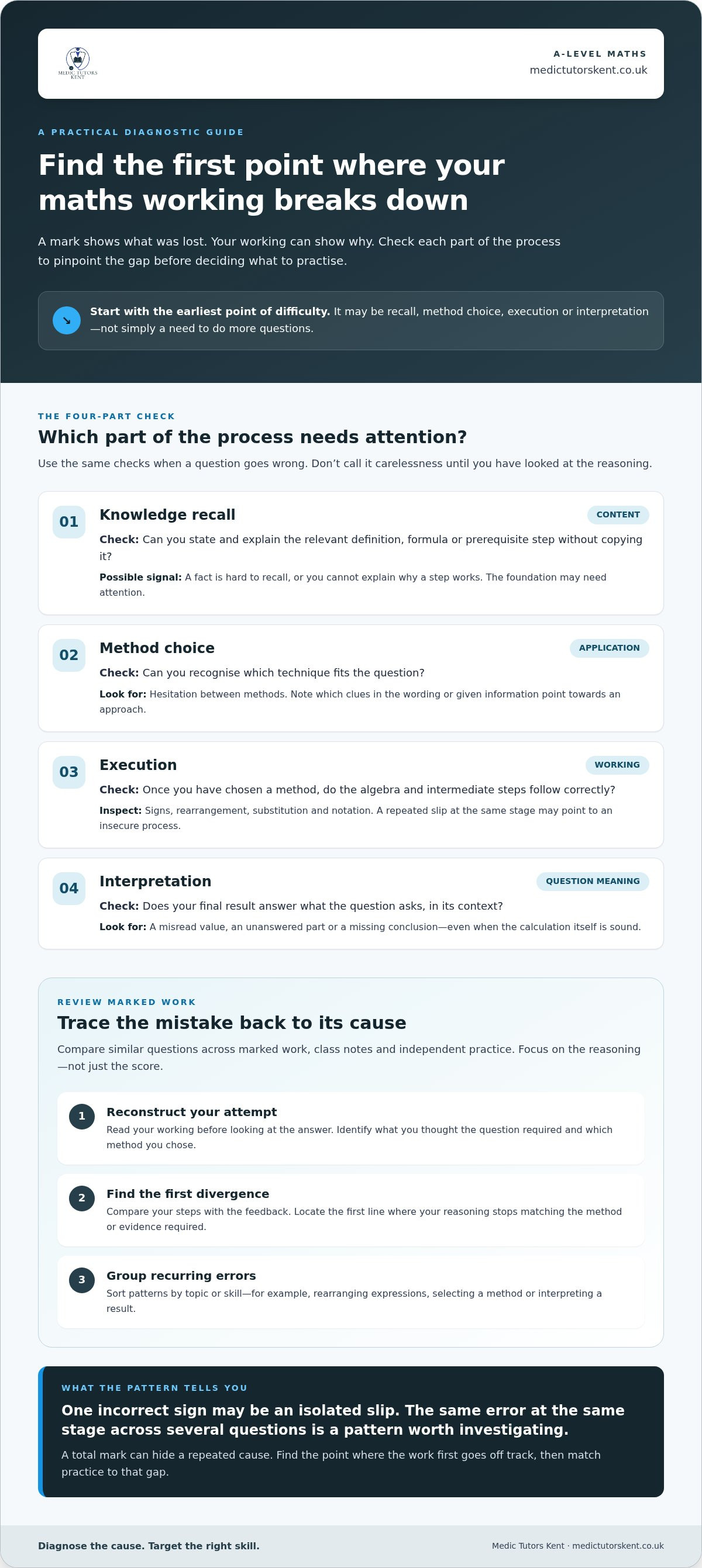
A mark tells you what was lost; the working shows why. To diagnose a recurring problem, examine the steps before the final answer, then compare similar questions across marked work, class notes and independent practice. Find the point where your reasoning first stops matching the method or evidence required. That point is more useful than the total score alone.
How can you tell whether the issue is knowledge, method or accuracy?
Use the same four-part check each time. Don’t label an error as carelessness until you’ve examined the reasoning. A small-looking slip may reveal an insecure idea or an unclear process.
- Knowledge recall: Can you state and explain the relevant definition, formula or prerequisite step without copying it? If you can’t explain why a step works, the foundation may need attention.
- Method choice: Do you know several techniques but hesitate over which one fits the question? Note what clues in the wording or given information point towards the appropriate approach.
- Execution: Once you choose a method, do the algebra and intermediate steps follow correctly? Check signs, rearrangement, substitution and notation rather than assuming the mistake was just a lapse in care.
- Interpretation: Does your final result answer the question in context? A sound calculation can still miss the point if you misread what a value represents or omit a required conclusion.
Recurring error patterns show which skill needs attention first. One incorrect sign may be an isolated slip. The same sign error across several questions, particularly at the same stage of working, is stronger evidence of a pattern worth investigating.
What should you look for in marked A-Level Maths work?
Choose several recent attempts, not just the paper with the lowest mark. Compare each original solution with the teacher’s feedback and locate the first line where your reasoning diverges. Group errors by topic or skill, such as rearranging expressions, selecting a method or interpreting a result. Counting lost marks alone can hide a repeated cause.
- Reconstruct the attempt: Read your working before looking at the answer. Identify what you thought the question required and which method you chose.
- Find the first divergence: Compare your steps with the feedback. Did a missing fact, an unsuitable method or an inaccurate line create the problem?
- Classify the feedback: Separate a misunderstood explanation from a correct method carried out inaccurately. These need different practice.
- Check for recurrence: Look for the same issue in class notes, homework and independent questions. Record the topic and precise step, rather than writing “careless mistake”.
This evidence turns revision into a targeted investigation. If the pattern remains unclear, discussing your working in tailored A-Level Maths tuition can help bring the specific blockage into focus. Collect the working and feedback that show where support may be most useful.
Choose the right response: independent practice, school support or an A-Level Maths tutor
The right support depends on the blockage, not on how much extra work you can fit in. If the method is clear but fluency is inconsistent, focused practice may be enough. If classroom explanations or the pace of a topic are causing difficulty, speak with your school. If you need a concept unpacked or help applying it to unfamiliar questions, tailored tuition may be useful.
Use this comparison to match the next step to the need:
Need: You understand the method but need more practice. Suitable support: Independent practice. Practical next step: Choose a small set of questions on the same skill, then mark and review each attempt.
Need: A topic remains unclear in lessons, or you need clarification about what the curriculum expects. Suitable support: School support. Practical next step: Take a specific question and your working to your teacher, and ask where your reasoning needs to change.
Need: You need focused explanation, structured diagnosis or guided practice with challenging questions. Suitable support: Private A-Level Maths tuition. Practical next step: Bring examples of the questions and steps that have been difficult, so support can target the underlying need.
When can independent practice or school support be a sensible next step?
Practise independently when you can explain the method and identify where it applies, but need repetition to make your working more reliable. Don’t complete a long mixed set by default. Select questions that exercise the same skill, check your answers and note whether the same error returns.
If the difficulty persists across lessons, raise it with your school. Teacher feedback can help turn “I don’t understand this topic” into a precise question, such as “I can set up the equation, but I’m unsure why this rearrangement is valid.” That gives the conversation a clear starting point and helps distinguish a missing explanation from a prerequisite that needs revisiting.
When might tailored A-Level Maths tutoring add value?
Consider one-to-one or small-group tuition when you need focused help with a complex concept, or when understanding a technique doesn’t yet translate into solving examination questions. The value lies in aligning support with the diagnosed need, not simply adding another stack of undirected exercises.
Medic Tutors Kent provides tailored A-Level Maths tuition to support subject understanding and exam readiness. Sessions connect curriculum-focused explanations with practice on challenging examination questions. Consider what would help most: identifying the gap, making a concept clearer or working through how to apply a method. That answer can guide your choice of support.
Build a focused A-Level Maths recovery plan, one gap at a time
A useful recovery plan is precise, limited in scope and reviewed against evidence. Don’t respond to a difficult topic by attempting every question again. Select one recurring issue, work out what supports it, then practise and check whether the same error appears. Use a clear cycle: identify, rebuild, apply and reassess.
- Select one recurring gap. Use marked work to name the specific difficulty, such as choosing an appropriate method or handling a particular algebraic step. Keep the target narrow enough to practise directly.
- Revisit the prerequisites. Identify the earlier fact or process the skill depends on. If a calculus question stalls because rearranging an expression is uncertain, secure that algebra before moving on.
- Practise the defined skill. Start with a straightforward example, then attempt questions that use the same process in less familiar forms. A short, focused set gives clearer evidence than a large batch of mixed questions.
- Review the working. Compare each attempt with feedback or a worked solution. Record where the reasoning changed and why the corrected step is valid, not just which answer to copy.
- Reassess independently. Return to a similar question later without notes. Check whether you can select the method, show the steps and explain the result without repeating the original mistake.
Productive revision pairs a defined skill with feedback on attempted questions. That feedback helps you decide whether to try a harder variation, revisit a prerequisite or narrow the target to one particular step.
How should you turn an error into a practical study task?
Rewrite the missed step in plain language. For example, “I expanded the brackets but didn’t apply the negative sign to every term.” Then identify the prerequisite: here, it may be understanding how multiplication by a negative affects each term. Choose a small sequence of questions that builds in complexity, and write down why the correction works. The aim is independent reasoning, not memorising one answer.
How can you check whether the intervention is working?
After practising, leave the notes aside and attempt a similar question later. Ask whether you can explain why the method applies, not simply reproduce familiar lines of working. Track the skill, your reasoning and whether the same error recurs. If it does, return to the diagnosis and make the target more specific. The missing element may be smaller than the topic label suggests.
If you want structured support to apply this cycle, explore tailored A-Level Maths tuition. Start with a clear account of the difficulty: what step breaks down, what you’ve already tried and what the feedback shows.
How an A-Level Maths tutor can support lasting subject understanding
Once you’ve identified where your reasoning breaks down, support can be directed at the cause rather than the symptom. Tailored A-Level Maths tuition can focus on your specific learning needs, connecting curriculum understanding with practice on challenging examination questions. The aim is to build stronger subject understanding and exam readiness, not to promise a particular grade or result.
What can a tailored tutoring session focus on?
A session can begin with a concept that feels difficult and work through what is unclear: the underlying idea, how to apply it or why a particular method fits the question. Guided work on a challenging examination question can then show where understanding holds and where another step needs attention. This links explanation to application instead of treating them as separate tasks.
Medic Tutors Kent provides tailored private one-to-one and small-group A-Level Maths tuition. Sessions can respond to the student’s needs and curriculum, whether that means clarifying a complex concept or developing the reasoning needed to approach demanding questions. Exam readiness develops through understanding and practice; it isn’t a guaranteed outcome.
A useful session should give the student more than a completed answer. They should have the opportunity to explain why a method applies, follow the reasoning through the working and consider how the same idea might appear in a different question. That process supports subject mastery rather than reliance on memorised steps alone.
What should students bring to their first focused session?
Bring evidence of the difficulty. Recent marked work, relevant class notes and teacher feedback can help connect the original attempt to the point where the reasoning became uncertain. You don’t need to arrive with a perfect diagnosis. One question you cannot yet explain confidently is a practical starting point.
- Recent marked questions: Include the original working and any written feedback, not just the final mark.
- Class notes: Bring material on the current topic and any earlier ideas that seem connected.
- A question to investigate: Choose one example and be ready to say which step feels least clear.
These materials make the learning need concrete. They can also show whether the challenge lies in understanding a concept, choosing an approach or carrying out the working accurately. Bringing this evidence helps anchor the discussion in actual questions rather than a general sense of being behind.
With the right focus, tutoring can turn a difficult question into a structured opportunity to understand the reasoning and practise applying it. If you’re ready to explore tailored A-Level Maths support, bring the question you want to understand more clearly.
Make your next step specific
Progress starts with a decision you can act on: choose the mathematical skill you want to strengthen, then decide what support will help you work on it. If you’re still searching for a “struggling with A level maths tutor”, focus on the learning need behind the search. Is there a complex concept you can’t yet explain, or do challenging examination questions leave you unsure how to begin?
Medic Tutors Kent offers tailored A-Level Maths tuition, with one-to-one and small-group sessions that support work on complex concepts and demanding examination questions. The focus is on building subject understanding and exam readiness through learning suited to the student’s needs, not promising a particular grade.
Take the question that has been holding you back and use it as the starting point for a clearer plan. Explore tailored A-Level Maths tuition and consider how focused support could help you approach your next challenge with greater understanding.
Frequently Asked Questions
Is it normal to struggle with A-Level Maths after GCSE?
Yes, the move can feel demanding because A-Level questions often require you to apply ideas in less familiar ways. Finding this difficult doesn’t, by itself, mean you lack ability. For a useful first check, choose a recent question you found hard and mark the exact point where you became unsure. Was it a term, an algebraic step or the way the question was worded? That detail helps you decide what to revisit.
Can an A-Level Maths tutor help if I do not understand my school lessons?
Yes. A tutor can provide tailored support with A-Level Maths concepts and challenging questions alongside your school learning. Bring a recent question that you couldn’t follow, plus the relevant class notes or feedback. You might ask for the explanation to be approached from another angle, then try a related question to check what has become clearer. Tutoring can support understanding, but can’t guarantee an examination result.
How do I know whether my A-Level Maths mistakes are careless or a knowledge gap?
Compare several attempts before deciding. If you can explain the method but lose accuracy in a calculation, check whether the same type of slip recurs and at what stage. If you can’t explain why a formula or method applies, revisit the concept or prerequisite. A simple error log can help: note the question topic, the first uncertain line and what you would do differently next time.
Should I revise the whole A-Level Maths course if I am falling behind?
Not automatically. Starting from the beginning may use time on material you already understand. Instead, list the topics in your recent work and note where questions become difficult. If the issue clusters around one area, focus there first. If the same prerequisite appears across different topics, address that foundation. Expand your revision plan when your marked work shows that difficulties are wider, rather than assuming you must relearn everything.
Can I get A-Level Maths tutoring alongside my normal sixth-form lessons?
Yes. Private A-Level Maths tuition can sit alongside your existing sixth-form course and support the topics you’re studying. To keep it connected to your lessons, bring the current topic, a question you found difficult and any feedback from class. You can then use the session to clarify the idea or practise applying it, while continuing with your usual teaching and coursework.
Does hiring an A-Level Maths tutor guarantee a higher grade?
No. A tutor cannot responsibly guarantee a particular grade or examination result. Tutoring can support subject understanding and exam readiness, but outcomes depend on the student’s starting point, learning needs, practice and other factors. Look for evidence of progress in the work itself: can you explain a concept in your own words, choose a suitable approach and set out your reasoning more clearly on an unfamiliar question?
